Hey there, let’s cut to the chase—if you’re reading this, you’re probably staring at a scratched or seized high-speed spindle bearing right now, wondering if you can skip the cost of a whole new unit. As a spindle bearings supplier who’s been in this game for 12 years, I’ve heard this question a hundred times: can damaged high-speed spindle bearings be repaired? The short answer? Sometimes—but not always, and it depends on what broke. Let’s break this down like we’re geeking out over a part that matters to your milling, grinding, or CNC setup. High Speed Spindle Bearings
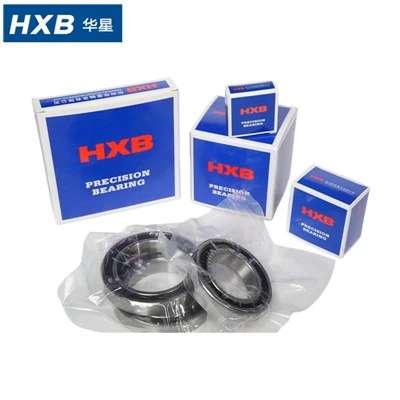
First, let’s set the scene: high-speed spindle bearings (we’re talking angular contact ball bearings, ceramic ball variants, or even hybrid types) run at 10,000+ RPM, with tiny tolerances measured in thousandths of an inch. A lot of stress goes into these bad boys—heat, vibration, radial loads, maybe a little over-lubrication that went wrong. So when damage hits, it’s rarely “a quick fix” like tightening a loose bolt. But there are cases where repair works.
Let’s start with what can be repaired. Minor surface issues are the main ones. If you catch wear early—like micro-pitting on the raceways that’s still tiny (no deep craters, no flaking), or a tiny nick on a ball that didn’t break the ceramic coating on hybrid bearings—we’ve seen success with precision lapping. Wait, lapping isn’t just for car engines, right? For spindle bearings, lapping uses a custom abrasive compound and ultra-smooth plates to buff out those minor imperfections without altering the bearing’s tight fit. We did this last year for a shop that ran a CNC grinder 24/7, and their bearing had only 0.0002-inch surface wear—after lapping, it ran as smooth as new, no heat spikes, no weird vibration. Another fix? If the seal is torn or the cage (the part that holds the balls) is bent out of shape slightly, we can swap the seal and straighten the cage with a CNC press—no need for a whole new bearing. But here’s the catch: this only works if the core components (the inner and outer rings) aren’t structurally compromised.
Now, the stuff that can’t be repaired—and this is where we have to be straight with you, no fluff. If you see things like flaking raceways (that’s when the metal peels off in chunks), a cracked inner or outer ring, or balls that are chipped or seized solid, repair is a terrible idea. Why? Because high-speed bearings rely on perfect concentricity—any structural damage throws that off. We once tried to “repair” a bearing that had flaked raceways for a customer; a week later, it seized up mid-operation, cost them $8k in a broken workpiece and downtime. It’s not worth the risk. Also, if the bearing has run past its L10 life (that’s the 90% reliability threshold, for those who don’t know), even minor damage is a sign the whole unit’s on its way out—repairing it just delays the inevitable, not solves it.
Wait, some folks ask: can we re-grind the raceways? Let’s get technical for a sec—no, not usually. The raceways on high-speed spindle bearings are hardened to 60+ HRC (Rockwell hardness), so re-grinding would take off too much material, messing up the contact angle (critical for high RPM) and the tolerance. If you do grind, you have to re-harden the surface afterward, which introduces stress and risk of warping. It’s a band-aid that ends up being more expensive than just buying a new bearing. That said, some specialty shops do this for very low-speed, non-critical applications—but not for our high-speed setups, which is what we supply.
Now, why would someone even consider repair? Let’s be real: a new high-speed spindle bearing can cost $500 to $5,000, depending on the type. Repair might be half that, right? But again, it’s a gamble. The key is having a trained tech inspect the bearing first. If you send us a damaged bearing, our team does a 5-step check: 1) measure raceway surface wear with a profilometer, 2) check for cracks with magnaflux (that’s the non-destructive test for metal flaws), 3) test the cage for alignment, 4) check the seal integrity, 5) verify the contact angle matches specs. If it passes 4 out of 5, we’ll go for repair; if not, we’ll push for a new one. We never sell a repair that’s a bad call—our reputation’s built on that.
Another thing to note: there’s a difference between “repair” and “reconditioning.” Reconditioning is just cleaning and re-lubing, which you can do yourself (if you have the right grease—we use a high-speed synthetic grease that’s formulated for 15k+ RPM). But if the bearing has actual damage, cleaning it won’t fix the wear. We get a lot of bearings sent in that are just caked in old grease, and after a deep clean, their surface wear is minimal—those are the ones we can fix with a lapping job.
Let’s talk about common mistakes people make when trying to repair. First, over-tightening the bearing after a “fix”—that creates too much friction, leads to heat, and kills the bearing fast. Second, using the wrong grease—regular bearing grease has too much viscosity at high RPM, so it causes drag. Third, ignoring preload: high-speed spindle bearings need precise preload (not too much, not too little) to run right. If you lap a bearing but mess up the preload, it’ll vibrate like crazy, wear out in a week.
So, to circle back: can high-speed spindle bearings be repaired? The answer is, “if the damage is superficial, and you work with a supplier that knows their spindle bearings, not a random machine shop that does auto parts.” At the end of the day, there’s no universal rule—every bearing, every damage case is different. We’ve repaired some that were 3 years old and still going strong, and we’ve had ones that looked “fixable” turn out to be total duds.
Now, if you’re staring at a damaged bearing, don’t guess. Send us the details—what kind of spindle you’re running, the RPM, the type of bearing (hybrid ceramic, angular contact, etc.), and a photo of the damage. Our team will give you a clear call: repair, or replace. No sales pitches, no hidden costs, just straight talk. We don’t want you to waste money on a repair that fails, just like we don’t want you to overpay for a new bearing when a fix works.
If you’ve got a spindle bearing that’s acting up—noises, heat, vibration—reach out to our team to chat about your options. We’re here to help you keep your operations running smooth, not stress over broken parts.
Motorcycle Bearings References:
- Harris, T. A., & Kotzalas, M. N. (2007). Rolling Bearing Analysis: Advanced Concepts of Bearing Technology (5th ed.). CRC Press.
- SKF Group. (2022). High-Speed Spindle Bearing Performance Guidelines. SKF Industrial Products Division.
- American Machine Tool Distributors’ Association (AMTDA). (2021). CNC Spindle Maintenance Best Practices. AMTDA Technical Bulletin 21-04.
Hangzhou Huaxing Kechuang Holding Group Co., Ltd.
Hangzhou Huaxing Kechuang Holding Group Co., Ltd. is one of the leading manufacturers and suppliers of high speed spindle bearings in China, featured by quality products and good service. Please rest assured to buy bulk durable high speed spindle bearings from our factory. Welcome to view our website for more information.
Address: No.553 Yingbin Road, Linping, Hangzhou, 311100, China
E-mail: wmb@huaxingbearing.com
WebSite: https://www.hxbbearing.com/
