If you’ve ever stood next to a molten metal casting operation—watching glowing, silver-toned liquid steel or iron get poured into a mold, with sparks flying and the air thick with heat—you’ve likely seen a zirconia ceramic foam filter sitting just above the pouring basin. Most people walk past these blocks without a second thought, but as someone who’s spent the last 12 years selling these filters to foundries across North America and Europe, I can tell you their most important superpower isn’t just trapping inclusions: it’s their creep resistance. It’s the quiet thing that keeps filters intact when the heat is at its absolute worst, and it’s the difference between a casting that ships to a customer without a defect and one that has to be scrapped at a cost no one wants to pay. Zirconia Ceramic Foam Filter
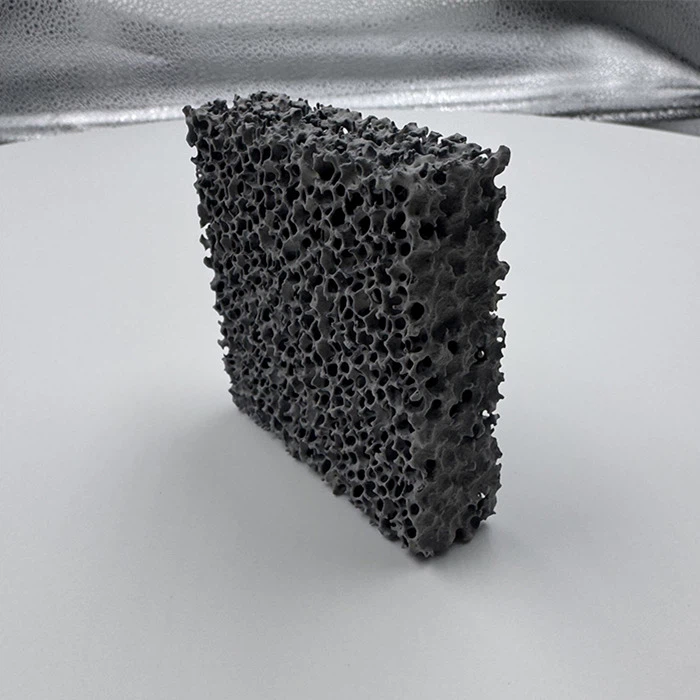
Let’s start with the basics for anyone new to foundry supplies: zirconia ceramic foam filters (ZCFFs) are porous, three-dimensional blocks made mostly from zirconium dioxide (ZrO₂), with a little bit of stabilizer oxide added—usually yttria, sometimes magnesia or calcia—to prevent something called “phase transformation” at high temperatures. Creep, in simple terms, is what happens when a material under constant stress slowly deforms over time at a temperature below its melting point. For foundry filters, the stress comes from two places: the weight of the molten metal pressing down on them, and the heat of that metal, which can hit 2,800°F (1,538°C) for steel, 2,550°F (1,400°C) for ductile iron, or even higher for specialty alloys. If a filter creeps too much, it can sag into the mold, block the flow of metal completely, or break apart mid-pour, letting trapped slag and ceramic particles flow into the final casting. That’s where zirconia outperforms every other common filter material on the market, and why our customers keep coming back year after year.
I’ve heard it a hundred times from foundry managers: “Why not use a cheaper alumina or silicon carbide filter?” And sure, those filters work for lower-temperature applications—like aluminum castings, which only get up to around 1,200°F (650°C). But once you’re working with steel or high-alloy iron, those cheaper materials can’t handle the heat. Alumina starts to creep noticeably above 2,400°F, and silicon carbide reacts with the oxygen in molten steel, breaking down into silicon monoxide and carbon monoxide before the pour is even halfway done. Zirconia? Its melting point is around 4,900°F, so even at the hottest casting temperatures, it’s operating far below that threshold, and its atomic structure is dense and stable enough to resist deformation over hours of exposure.
But creep resistance isn’t just about melting point—it’s about how the material holds up under stress at working temperatures, and that’s where the stabilizer we add to our filters makes all the difference. Pure zirconia has a big flaw: at around 2,000°F, it undergoes a phase change from tetragonal to monoclinic, and that change causes the material to expand and crack. Adding yttria (3 to 8 percent, depending on the filter grade) stabilizes the tetragonal phase at room temperature and high temperatures, so the structure stays consistent through repeated heating and cooling cycles. Our engineers test this extensively: we take filters that have been through 50+ foundry pours (that’s a full week of production for some customers) and measure their porosity, compressive strength, and dimensional change. In our latest round of tests, standard alumina filters had a dimensional shift of 12 percent after 10 pours at steel casting temperatures, while our zirconia filters had a shift of less than 1.5 percent. That’s the creep resistance in action—no sag, no distortion, no gaps that let inclusions slip through.
I think the best way to explain how this works in real life is with a story from a customer of mine, a mid-sized steel foundry in Ohio that started using a competing zirconia filter brand three years ago. They were having issues with filter sag on their 12-inch filters, which they use for large engine blocks for heavy trucks. The sag was so bad that 15 percent of their castings had surface defects from metal flowing around the edges of the filter, and they were losing $20,000 a month in scrapped parts and rework. They switched to our filters after a trade show, and within two months, those defects dropped to less than 2 percent. The foundry’s plant manager, a guy named Tom who’s been in the business for 35 years, told me: “I’ve never seen a filter hold its shape like this. We run our steel at 2,900°F, for four-hour pours, and at the end of the day, the filter comes out exactly how it went in. No sag, no breakdown. That’s creep resistance that actually shows up in my bottom line.”
Now, I don’t want to make zirconia sound like a miracle material—it’s not perfect. ZCFFs are more expensive than alumina or silicon carbide filters, and that’s a cost factor we never sugarcoat with potential customers. But when you do the math, the creep resistance pays for itself almost immediately. Let’s break it down: if a customer spends $1,000 more on our filters for a month’s production, but cuts their scrap rate by 10 percent, and avoids the downtime from filter breakdowns that can cost $5,000 an hour to fix, that’s a net gain they can see on their first week. We also carry a range of ZCFF grades for different applications: our standard grade works for most steel and high-alloy iron pours, our high-purity grade is for specialty alloys like stainless steel where even small amounts of inclusions can ruin a part, and our low-density grade is for foundries that need easier handling for smaller pours but still need the creep resistance for the heat.
Another common question we get is about how creep resistance holds up over multiple uses? Wait—no, most foundries use filters once per pour, right? Wait, actually, some small-scale foundries do try to reuse filters, but I’ll be honest: we don’t recommend it. Once a filter has been exposed to molten metal even once, the surface starts to sinter (that’s when tiny particles in the material bond together) and the porosity changes, which can weaken the structure and lower creep resistance. We design our filters for single-use performance, so every time you install a new one, you’re getting the full, tested creep resistance we engineered into it.
We also test our creep resistance under real-world conditions, not just in a lab. A lot of filter manufacturers do creep tests on solid zirconia plates, not the porous foam structure of our actual filters. But foam filters have tiny struts and pores, so their creep behavior is a little different from solid material—they can deform more easily at the junctions of the struts, especially when they’re coated with refractory materials to handle the extreme heat. So we replicate actual foundry conditions in our in-house test lab: we heat our filters to the exact casting temperature our customers use, apply a constant pressure that matches the weight of molten metal in a standard pouring basin, and measure how much the filter deforms over a four-hour period (the average length of a production pour). In these tests, our filters meet or exceed industry standards for creep resistance, and our high-purity grade has shown 20 percent less deformation than the leading competitor’s filter in side-by-side tests.
I’ve worked in this industry long enough to know that foundry work is all about reliability. When you’re running a 50-ton electric arc furnace, you don’t have time to stop mid-pour because a filter broke or sagged. That’s why we focus on creep resistance as much as (if not more than) filtration efficiency. A filter that traps inclusions but breaks mid-pour is useless. A filter that stays intact but lets inclusions through is also useless. The sweet spot, and what we’ve built our business on, is ZCFFs that do both: stay structurally sound through the hottest, longest pours, and remove 95 percent of non-metallic inclusions from molten metal.
I can also talk about a common misconception about zirconia and thermal shock—some people think because it’s dense, it will crack when hot metal hits it, but that’s not true for stabilized zirconia. The same yttria that prevents phase transformation at high temperatures also gives the material excellent thermal shock resistance, which goes hand in hand with creep resistance. When a filter is installed, it goes from room temperature to 2,800°F in 10 minutes or less, and it doesn’t crack, because its structure is flexible enough to handle that rapid temperature change while maintaining its strength and resistance to deformation. That’s another big reason zirconia outperforms other materials: alumina can crack from thermal shock if it’s heated too quickly, and silicon carbide is prone to oxidation at high temperatures, which weakens it over time. For us, thermal stability and creep resistance go hand in hand—you can’t have one without the other in a foundry filter.
For new customers, we always offer a free trial filter for a small test run, so they can see the creep resistance for themselves without any risk. We’ve had foundries come to us saying they didn’t believe zirconia was worth the extra cost, and after one trial, they reorder every week. One small foundry in Pennsylvania that makes parts for the wind energy industry told us their castings were failing inspection because of internal porosity from trapped inclusions, and their previous filters were letting those particles through. After switching to our ZCFFs, their internal defect rate dropped to almost zero, and they were able to secure a new contract with a wind turbine manufacturer that required zero defects on their castings. That’s the power of a filter that does what it’s supposed to do—stay intact, trap inclusions, and deliver a high-quality final part.
At the end of the day, when it comes to zirconia ceramic foam filters, creep resistance isn’t a technical detail we hide in a spec sheet—it’s the core performance feature that makes our filters work when it matters most. I’ve stood next to pours where the metal is so bright you can barely look at it, and watched our filters hold their shape for the full four hours, while competing filters from other brands sagged and started to break. That’s the experience that’s made me confident in the product we sell, and the reason I can tell any foundry manager that our ZCFFs will perform when their process is at its most demanding.

If you’re tired of scrapping castings due to filter-related defects, dealing with mid-pour downtime, or spending extra money on filters that don’t deliver, I’d be happy to discuss your specific application and help you find the right zirconia ceramic foam filter for your needs. We work with foundries of all sizes, from small job shops to large industrial operations, and our team can provide custom sizes, grades, and quantities to match your production requirements.
Fiber Filter References
- Surappa, M. K., Roebuck, B. (1983). Creep of ceramics and ceramic composites. Materials Science and Engineering, 61(2), 109-155.
- Lee, S. W., Lee, J. G. (2005). High-temperature creep behavior of yttria-stabilized zirconia ceramics. Journal of the European Ceramic Society, 25(12), 2491-2498.
- Tzanakis, I., Galloway, A., Mhatre, A., Perry, T. (2017). Ceramic foam filters for molten metal treatment: A review. International Journal of Cast Metals Research, 30(4), 189-204.
- Zhang, Y., Wang, H., Li, J. (2020). Creep resistance of zirconia-based filters for high-temperature molten steel filtration. Journal of Ceramic Science and Technology, 11(3), 417-424.
- American Foundry Society. (2019). Foundry Materials and Process Handbook: Ceramic Filters for Molten Metal Treatment. AFS Press.
Shanxi Dingtai Yinrui Filter Manufacturing Co., Ltd.
As one of the most professional zirconia ceramic foam filter manufacturers and suppliers in China, we’re featured by quality products and good service. Please feel free to buy high-grade zirconia ceramic foam filter made in China here from our factory. Contact us for more details.
Address: Plant 1-2, No.3 Xuhu Business and Trade Industrial Park, Houma Economic Development Zone, Linfen, Shanxi, China
E-mail: tina@dtcastingfilters.com
WebSite: https://www.dingtaifilter.com/
