As a supplier of Cylindrical 21700 Li – ion Batteries, I’m often asked about one crucial question: How long does a Cylindrical 21700 Li – ion Battery last? This question is of significant interest not only to consumers but also to businesses involved in the battery – using industries. Let’s delve into the factors that determine the lifespan of these batteries and provide a comprehensive understanding. Cylindrical 21700 Li-ion Battery

Understanding the Cylindrical 21700 Li – ion Battery
The Cylindrical 21700 Li – ion Battery is a rechargeable lithium – ion battery with a standard size of 21mm in diameter and 70mm in height. It has gained popularity in recent years due to its high energy density, which allows for more power storage in a relatively small space. These batteries are widely used in electric vehicles (EVs), power tools, and energy storage systems.
Factors Affecting the Lifespan of Cylindrical 21700 Li – ion Batteries
1. Cycle Life
The cycle life of a battery refers to the number of complete charge – discharge cycles it can undergo before its capacity falls to a certain percentage (usually 80%) of its original capacity. For high – quality Cylindrical 21700 Li – ion Batteries, the cycle life can range from 500 to 2000 cycles.
In applications like power tools, which may have relatively shallow charge – discharge cycles, the battery can last for a large number of cycles. On the other hand, electric vehicles often require deeper discharges, which can reduce the overall cycle life. For example, if an EV battery is regularly discharged to a very low state of charge and then recharged fully, the stress on the battery’s internal components is higher, leading to a shorter cycle life.
2. Depth of Discharge (DoD)
The depth of discharge has a significant impact on the lifespan of the battery. A shallow discharge, where the battery is only partially depleted before recharging, is less stressful on the battery compared to a deep discharge.
Let’s assume we have a Cylindrical 21700 Li – ion Battery with a rated capacity of 5Ah. If we only discharge it to 80% of its capacity (i.e., 1 Ah is used) and then recharge it, this is a shallow discharge. In contrast, if we discharge it to 20% of its capacity (i.e., 4 Ah is used), it is a deep discharge. Batteries that are subjected to frequent deep discharges will generally have a shorter lifespan.
3. Charge and Discharge Rates
The rate at which a battery is charged and discharged also affects its longevity. Charging or discharging a battery at a high rate generates more heat, which can cause damage to the battery’s electrodes and electrolyte.
For example, if a Cylindrical 21700 Li – ion Battery is designed to be charged at a maximum rate of 1C (where 1C means charging the battery from 0% to 100% in one hour), charging it at a 2C rate will increase the stress on the battery. High – rate charging can cause lithium plating on the anode, which reduces the battery’s capacity and can even lead to safety issues over time.
4. Operating Temperature
The operating temperature of the battery is another critical factor. Lithium – ion batteries perform best within a certain temperature range, typically between 20°C and 40°C.
When the battery operates at temperatures below 0°C, the chemical reactions inside the battery slow down, reducing its capacity and power output. On the other hand, high temperatures above 40°C can accelerate the degradation of the battery’s materials, leading to a shorter lifespan. For instance, in hot climates, if the battery is not properly cooled, its performance and lifespan will be significantly affected.
Real – World Lifespan Estimates
In real – world applications, the lifespan of a Cylindrical 21700 Li – ion Battery can vary widely depending on the usage conditions.
In power tools, which are often used intermittently and with relatively low – stress charge – discharge cycles, a Cylindrical 21700 Li – ion Battery can last for 3 to 5 years. During this time, operators can expect to perform several hundred to over a thousand charge – discharge cycles, depending on the frequency of use.
In electric vehicles, the lifespan is more complex to estimate. If the vehicle is driven and charged under optimal conditions (moderate temperatures, shallow discharges), the battery can last for up to 10 years or more. However, in harsh environments or with aggressive driving and charging habits, the battery’s lifespan may be reduced to 5 – 7 years.
In energy storage systems, which are used to store renewable energy, the lifespan can be similar to that of EV batteries. If the system is properly designed and managed, with appropriate temperature control and charge – discharge strategies, the Cylindrical 21700 Li – ion Batteries can have a long – term service life.
Extending the Lifespan of Cylindrical 21700 Li – ion Batteries
As a supplier, I understand the importance of helping our customers extend the lifespan of our batteries. Here are some practical tips:
1. Avoid Deep Discharges
Maintain the battery’s state of charge between 20% and 80% whenever possible. If the battery is used in a device that allows for it, set up alerts or limits to prevent over – discharge.
2. Optimize Charge and Discharge Rates
Use chargers and controllers that are compatible with the battery’s rated charge and discharge rates. Avoid fast – charging unless necessary, and always follow the manufacturer’s recommendations.
3. Temperature Management
In applications where temperature control is possible, ensure that the battery operates within the recommended temperature range. This may involve using cooling systems in hot environments or insulation in cold environments.
4. Regular Maintenance
Periodically check the battery’s performance and condition. This can include measuring the battery’s voltage, capacity, and internal resistance. If any signs of degradation are detected, take appropriate measures such as replacing the battery or adjusting the usage pattern.
Conclusion
The lifespan of a Cylindrical 21700 Li – ion Battery is influenced by multiple factors, including cycle life, depth of discharge, charge and discharge rates, and operating temperature. By understanding these factors and adopting appropriate usage and maintenance practices, users can significantly extend the battery’s lifespan.
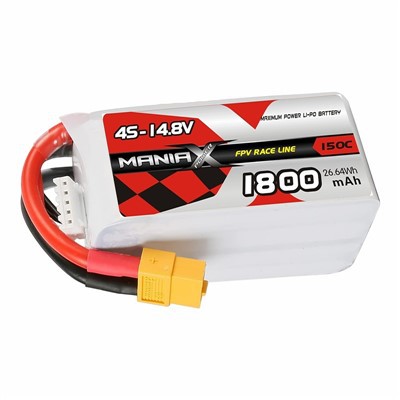
4.45V Drone Solid-state Lipo Battery 280Wh/kg At our company, we are committed to providing high – quality Cylindrical 21700 Li – ion Batteries that meet the highest standards of performance and durability. If you are interested in purchasing our batteries or have any questions, please feel free to contact us for a detailed discussion. We look forward to collaborating with you to meet your battery needs.
References
- Linden, D., & Reddy, T. B. (2002). Handbook of Batteries. McGraw – Hill.
- Tarascon, J. M., & Armand, M. (2001). Issues and challenges facing rechargeable lithium batteries. Nature, 414(6861), 359 – 367.
- Xia, Y. S., et al. (2019). A review of the features and analyses of the solid electrolyte interphase in Li – ion batteries. Chemical Reviews, 119(7), 4471 – 4513.
ManiaX Power Technology Co., Ltd.
ManiaX Power Technology Co., Ltd. is one of the most reliable cylindrical 21700 li-ion battery manufacturers and suppliers in China, also supports customized service. Please feel free to wholesale bulk durable cylindrical 21700 li-ion battery made in China here from our factory.
Address: Room 1508, 15/F, Two Grand tower, 625 Nathan Road, Kowloon, HongKong. P.R. China
E-mail: info@maniax-power.com
WebSite: https://www.maniaxpower.com/
